
2019
Cycling Unlimited assumes the organisation of the Tour de Suisse (the first event will be staged in 2020).

At the Tour de Suisse we are committed to playing our part in climate protection. We conducted an analysis of our racing emissions last year and are working on various initiatives to reduce them.
We are committed to reducing our emissions by 50% over the next 5 years and achieving Net Zero within the decade. We plan to achieve this primarily by reducing emissions wherever possible.
To reaffirm our commitment, we signed up to the United Nations Sports for Climate Action (S4CA) principles in 2020. Below you can learn more about climate issues related to cycling, our activities and those of our ecosystem. Contact us here if you have any questions.
Cycling Unlimited assumes the organisation of the Tour de Suisse (the first event will be staged in 2020).
We have joined the United Nations Sports for Climate Action (S4CA) framework.
We conducted our first emissions assessment for the race in collaboration with Quambio, a Swiss company based in Neuchâtel. We offset nearly 100 metric tons of emissions, representing a large portion of our Scope 1 and 2 emissions.
We joined the UCI Sustainability Working Group, a cycling-specific subgroup of S4CA. We organized our first mobility competition for spectators to promote public transport.
Building on the 2022 emissions assessment, we launched several initiatives to set us on the path to reducing our emissions. We again organized a mobility competition for our fans and spectators. We partnered with the teams participating in the Tour de Suisse to create the first-ever summary of teams’ sustainability strategies. We surveyed our local organizing committees to understand the challenges that local committees face in the context of sustainability. We also worked more actively with our sponsors to align our vision and actions on this important topic.
The experience gained over the past year was used to refine our strategic direction and to optimize our activities. The outcomes included an extended mobility competition for spectators in the Tour de Suisse Fan Zone, additional work to raise awareness of climate issues among the local organizing committees, active exchanges with the UCI, Swiss Cycling and the UN Sports4Climate Action committees regarding the transfer of know-how and our own efforts to reduce our own greenhouse gas footprint. We also organized our first ever Sustainability Award.
Innovation: Tour de Suisse Sustainability Award 2024
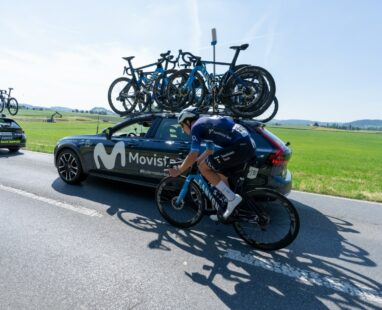
Team Movistar won the first Tour de Suisse Sustainability Award – the world’s first sustainability award in favor of a World Tour team by a Tour organizer.
The decisive factors for the selection were their proven track record over many years, defined reduction strategies and the integration of the entire team in the action plan. The team won a symbolic prize in favor of a charitable organization of its choice. The athletes also wore a special blue race number during this year’s race.
In 2025, we organized the second edition of the Tour de Suisse Sustainability Award. The Award was attributed to Team Cofidis, which among all the teams showed the most progress on sustainability issues between 2024 and 2025.
We also launch a new mobility challenge program, aimed at the cyclists among our fans, which features our host cities. Over a period of six months, participants were able to collect points and rewards when cycling to the host cities of the 2026 Tour de Suisse.
We also inserted sustainability questions into our general fans’ survey. The results were encouraging. Our efforts over the past three years mean that today, more than 70% of
our fans know about our climate actions, a significant increase in rece. The survey also provided more insights on how spectators travel to the event and the distances covered.
We plan to focus our activities in the coming months on the race structure, on fans programs and on continuing to raise awareness. Late last year, we announced the new format of the Tour de Suisse, in particular our intent to run both men and women races in parallel in race hubs. While sustainability is not the primary motivation for the new format, we are eager to see how this new approach helps us reduce our emissions and impacts in the coming edition.